
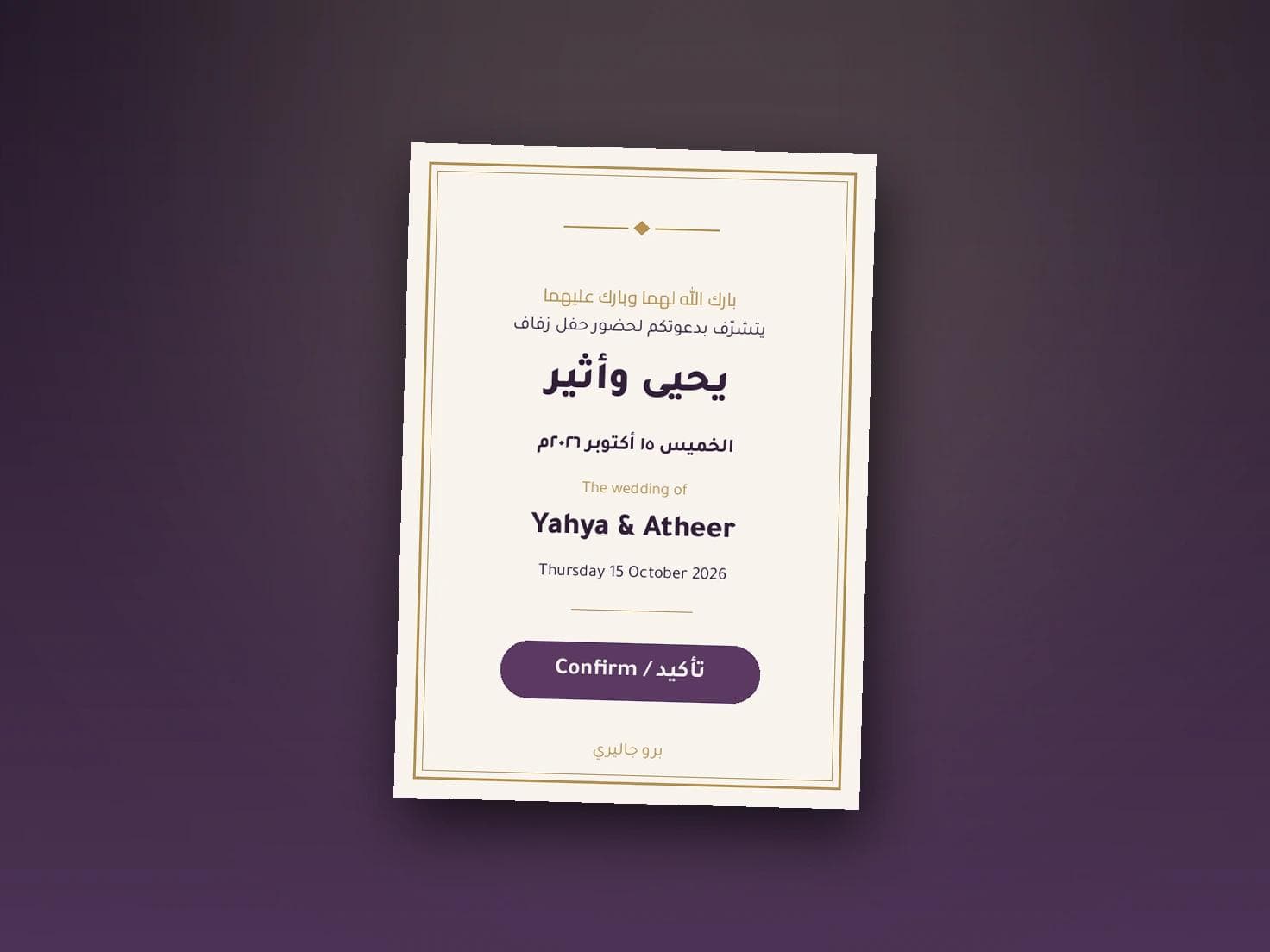
Bilingual Wedding Invitations: When and How
Many events now include guests who do not read Arabic: colleagues, or friends from abroad. The common fix is to squeeze both languages onto one card, and that is the worst of the three options.
Why a combined card fails
Arabic reads right to left and English left to right. Put both in one space and the alignment breaks while the type shrinks for both. The result is a crowded card that serves neither reader.
The three options
- Two separate cards. Same design, same colours, and each guest receives the version he reads. This is the best answer in practice.
- Two sides of one card. Arabic on the front, English on the back. Better suited to print than to a phone.
- Arabic with two English lines. The card is fully Arabic, with the date and venue repeated in English on two lines kept completely separate from the Arabic text.
The rule that prevents garbled text
Never place an English word inside an Arabic sentence. A mixed line reorders itself on some devices and becomes unreadable. The rule is simple: each language on its own line, and never a single Latin character in the middle of an Arabic line.
Names and dates
Names are written in each version's own language. The date is Gregorian in the English version and both calendars in the Arabic one. The time is identical in both, and remember to give the reception time rather than the dinner time.
In Pro Gallery invitations you prepare two versions of the same design, choose which one each guest receives, and control the typeface, colours and line order of each version independently.
Prepare both versions
Design your card once, then send every guest the version he can read. Start with Pro Gallery here.